
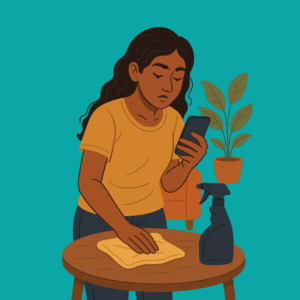
What if the things that help you feel better are also quietly keeping your anxiety going?
It’s easy to assume that anxiety comes from what’s happening to us. What if part of it comes from how we respond?
I recently read Building a Non-Anxious Life by Dr. John Delony, and one insight stayed with me: sometimes we unintentionally stay anxious because of how we try to cope.
We live in a world that makes it really easy to disconnect. Screens in our hand and stress all around us, we don’t even have to try to distract ourselves. Avoidance is built into our routines now, through scrolling, multitasking, background noise, endless to-do lists, and even productivity. It’s not always conscious. Sometimes, it’s just what we’ve been conditioned to do.
The problem is, avoidance may bring temporary relief, but it doesn’t bring long-term calm. We might even loose connection to what’s actually worrying us, and just feel a general sense of overwhelm. Distractions can soothe for a moment, but often they keep stress and anxiety lingering beneath the surface, dragging out our suffering.
Distraction Isn’t the Enemy. Disconnection Is.
Distraction is not always harmful. A favorite show, a walk, a playlist, or even tidying up can support regulation and give your mind space to breathe. What makes distraction unhelpful is when it becomes our default response, used every time discomfort arises. From this, distraction may become a subconscious go-to. We tell ourselves we’re working hard at cleaning our closet or garage, but we’re actually trying to stay busy because when we slow down things feel too heavy.
The line between self-soothing and avoidance is easy to cross, especially when we don’t even realize we’re doing it.
This is where mindfulness matters. Being mindful means slowing down enough to notice what we’re doing and why. It helps us create space between a feeling and a reaction, allowing us to respond with intention rather than reflex. The more we practice paying attention in the moment, the more we can catch ourselves in the act of avoiding, and gently choose a different path.
Avoidance Can Be Subtle
Many people think avoidance looks like “checking out.” It can also look like staying busy, being overly helpful, or jumping into action the moment we start to feel something uncomfortable. Here are a few subtle signs that distraction might be blocking your healing:
- Constantly multitasking or keeping your schedule full
- Reaching for your phone during quiet moments
- Shifting focus to someone else’s problems instead of your own
- Feeling edgy or overwhelmed when nothing is “wrong”
- Struggling to answer the question, How do I feel right now?
Avoidance is often a survival strategy. The problem is, when it becomes a habit, we disconnect from our needs, emotions, and inner signals and that disconnection can quietly feed anxiety.
What Helps Instead
If you’ve found yourself in a loop of distraction, you’re not alone. Many of us were never taught how to slow down, feel, or respond to ourselves with care. Narratives around productivity, along with intergenerational patterns of staying in survival mode, can reinforce this way of living. We learn to keep going, to stay useful, to stay distracted. Over time, it becomes second nature to avoid rather than connect.
Here are a few gentle ways to begin reconnecting:
- Pause and notice.
When you catch yourself reaching for your phone, cleaning obsessively, or launching into work mode, ask: What might I be feeling right now? - Name the moment.
Giving language to your experience helps you step out of auto-pilot. Try: I feel tense. I feel stuck. I feel restless. - Create intentional stillness.
Even two minutes of quiet breathing or sitting in silence can help you reset your nervous system and build tolerance for stillness. - Respond with curiosity, not criticism.
Avoid asking “Why am I like this?” and instead try “What do I need?” Self-compassion builds clarity.
Distraction isn’t inherently bad. The challenge is that we now live in a world full of constant noise, stimulation, and digital escape routes. Without meaning to, we can train ourselves to avoid the very emotions that would guide us toward peace.
The more we practice being present, the more access we have to truth, healing, and growth. You don’t need to figure it all out in one day. You just need to start by noticing. That alone is powerful.
Find this book and more on my book list Therapy Bookshelf
Check Out Other Mental Health Blog Articles
Breastfeeding’s Mental Load: Honoring Your Mental Health in Motherhood
Breastfeeding is often portrayed as a natural, instinctive part of motherhood; something your body is just supposed to know how to do. For many moms,...
No Results Found
The page you requested could not be found. Try refining your search, or use the navigation above to locate the post.
No Results Found
The page you requested could not be found. Try refining your search, or use the navigation above to locate the post.
No Results Found
The page you requested could not be found. Try refining your search, or use the navigation above to locate the post.