
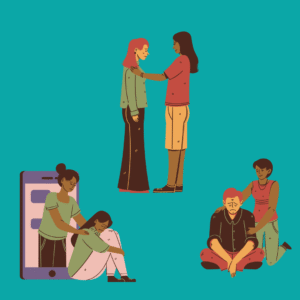
A Therapist’s Reflection
In therapy and in life, I meet many people who are “the one others lean on.” You know the type who are calm in a crisis, dependable under pressure, quick to problem-solve, slow to show distress. They’re the friends, family members, and professionals who hold it all together. I know this person well, not just from my clinical work, but from within myself. It’s a role that can feel meaningful, but it can also be isolating, exhausting, and quietly overwhelming.
When you’re the one others lean on, it’s easy to minimize your own needs. You might not realize you’re overwhelmed until you can’t focus or find yourself binge-watching something you’ve already seen, and find yourself numb. You might know you need support but can’t figure out how to ask, so you stay silent and wonder why you feel heavy.
The Invisible Load of Being the One Who Holds It Together
For those of us who tend to take on this role, many learned early on that being needed made us valuable. Maybe you were the responsible one in your family, the peacekeeper, or the one praised for being mature beyond your years. If that sounds familiar, there’s a good chance you gravitated toward roles that center care in your professional life, therapist, nurse, teacher, coach, or caregiver. You likely bring this role with you to work, even if your profession isn’t centered on care.
Over time, this way of being becomes part of your identity. While it can feel empowering to be steady and reliable, it can also become a mask, a way of never letting your guard down, never showing the parts of yourself that are tired, confused, or struggling. I see this often in the therapy room: people who don’t know how to ask for help without guilt, who only feel safe when they’re in control, who feel like a burden when they finally do speak up.
Signs You Might Be Carrying Too Much
Here are some subtle patterns that show up when you’re holding more than you realize:
- You feel irritable or emotionally numb after everyday interactions
- You rarely ask for help, even when you really need it
- You feel guilty for taking breaks or setting boundaries
- You worry constantly about letting people down
- You pride yourself on being “low-maintenance” or “fine”
These aren’t flaws, they’re coping strategies, but over time, they can lead to burnout, loneliness, compassion fatigue and even resentment. You may find yourself stuck in cycles like:
- Working non-stop without breaks, then swinging to full shutdown and procrastination because you feel paralyzed by overwhelm.
- Keeping your guard up so tightly that you don’t share anything, or swinging to oversharing in spaces where it might not feel safe or reciprocated.
- Telling yourself you “should” be fine while quietly sinking into exhaustion or sadness
Often, this means your nervous system doesn’t feel safe enough to rest. You’re in survival mode, even when no one can see it.
Where the Role Begins: Understanding the Roots of Over-Responsibility
The drive to be dependable often doesn’t start in adulthood; it’s shaped over time, often long before we’re aware of it. While being needed can make us feel valuable, other narratives also reinforce this role. For many who grew up in immigrant families, there’s often an unspoken expectation to be strong, to not add to the weight our caregivers were already carrying. In homes shaped by financial stress, language barriers, or cultural dislocation, children often step into emotional caretaker roles early, hoping to keep the peace or ease tension.
Even in homes where there wasn’t outright trauma, there may have been subtle chaos, mental health that wasn’t talked about, stress that simmered beneath the surface, or a general sense that expressing needs was risky. In these environments, learning to stay quiet, helpful, and composed wasn’t just a personality trait, it was survival.
For others, the reinforcement was quieter but just as impactful. Maybe you were consistently praised for being mature, helpful, responsible, the “easy” child who didn’t need much. In those moments, the role of being dependable may have felt like love, but over time, that praise can create pressure. When someone who is typically composed has a natural emotional reaction or breaks down, the response from others can be shock, disappointment, or even withdrawal. This can send the message that acceptance is conditional, that your worth is tied to how well you perform or support others. For many, those patterns didn’t disappear with adulthood. They evolved into hyper-independence, people-pleasing, or emotional suppression.
Understanding where these tendencies come from doesn’t mean blaming the past. It means gently naming what shaped us, so we can decide how we want to move forward.
How to Gently Take Up Space Again
Taking up space isn’t about swinging to the other extreme. It’s about building capacity for balance, considering where your needs can exist alongside your care for others.
The path to reconnection doesn’t have to be grand. Small steps matter. You might try:
- Asking for something small: A favour, a kind word, a moment of someone’s time
- Questioning old beliefs: Whose voice told you it was selfish to have needs?
- Creating space for support: Therapy, peer groups, or moments of quiet reflection
- Letting it be awkward: Receiving care might feel awkward at first, that’s okay.
You Deserve to Be Held Too
You don’t need to be at rock bottom to be worthy of support. You don’t have to prove your struggle to justify rest. You are more than a role. You are more than what you give.
Let this be a reminder: If you’re the one others lean on, you deserves space and support too.
You don’t have to carry it all on your own. If you’re looking for a space to reconnect with your needs and unlearn the pressure to be everything for everyone, therapy can help. Reach out to learn more or book a consult. You can also explore our upcoming events calendar
Check Out Other Mental Health Blog Articles
Father’s Mental Health: Breaking the Silence
Becoming a father is a huge life transition. Often painted as a time of great joy and fulfillment, this period is also marked by the challenges of...
Savouring Summer
Summer has just begun and many of us have our calendar filled right to September. We can see the summer slipping by before it even gets into the swing of...
No Results Found
The page you requested could not be found. Try refining your search, or use the navigation above to locate the post.
No Results Found
The page you requested could not be found. Try refining your search, or use the navigation above to locate the post.